

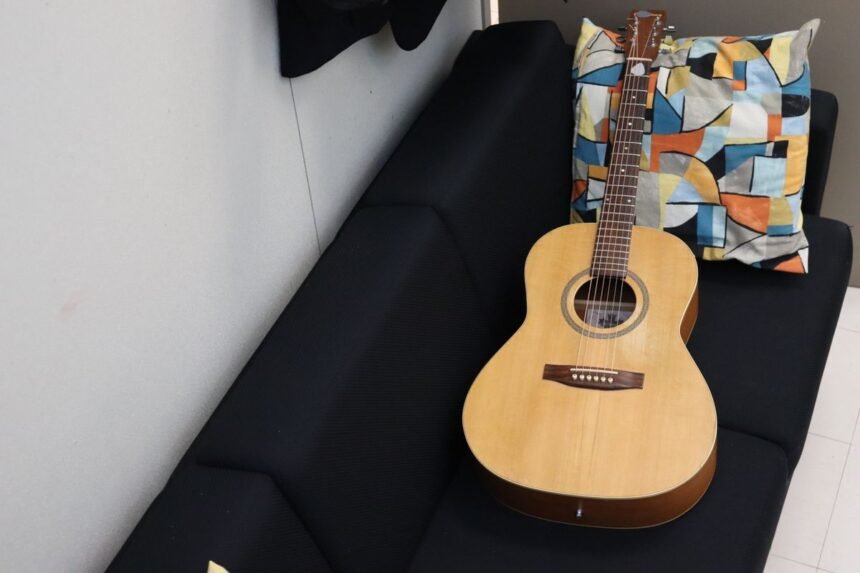
Many travel guitars are carbon fibre, collapsible-neck or headless designs, or carry a name most UK buyers have never heard of. The Fender California Standard Redondo Mini is a plain, no-electronics, laminate-body mini acoustic from a brand you’d recognise from a high-street shop window. It’s not trying to reinvent how a travel guitar works, it’s just a small, honest acoustic with a Fender badge and a distinctive six-in-line headstock.
Best for: someone who wants a simple, no-fuss mini acoustic from a brand they already trust, without paying for carbon fibre, a folding neck, or electronics they won’t use. If you want a full-scale neck, onboard electronics, or the best possible tone at this size, there are better-suited guitars elsewhere on this site.
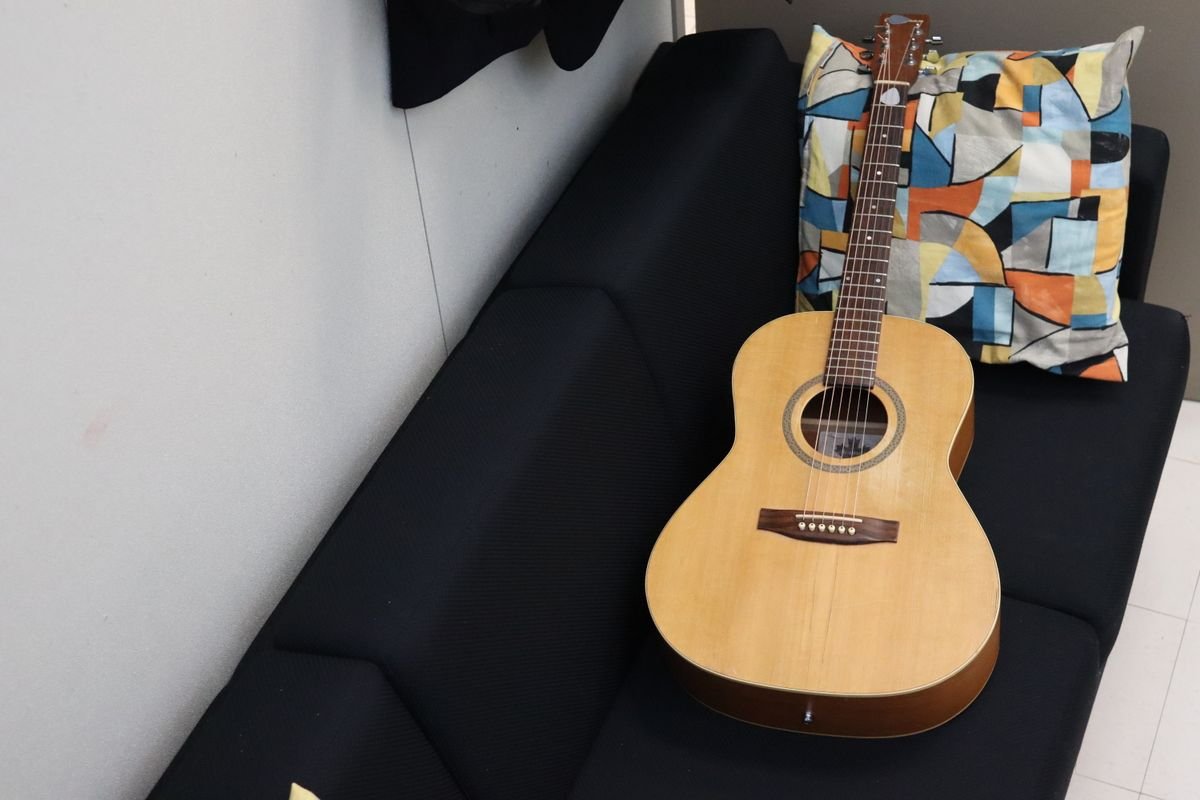
A compact acoustic guitar in a real living room, close in size to the Redondo Mini’s half-size dreadnought body.
A Fender shape you’ll actually recognise
The giveaway is the headstock. Fender builds every guitar in its California Series, acoustic or electric, around the same six-in-line design it made famous on the Stratocaster, tuners running in a straight line along one edge rather than three-a-side. On an acoustic body, that’s genuinely unusual, most travel and mini acoustics stick to a symmetrical classical-style head, and it’s the one detail that makes the Redondo Mini instantly identifiable as a Fender from across a room.
The version reviewed here is the Black Spruce Top finish, a black-finished spruce top over the laminated sapele back and sides Fender uses across the California Standard Redondo Mini range, with a gloss polyurethane body finish and ivory binding. It’s a half-size dreadnought-shaped body, the same silhouette as a full-size Fender acoustic just built smaller throughout, rather than a novelty shape designed around portability first. That matters for how it actually sounds: a laminate sapele body isn’t going to compete with a solid-top guitar for resonance, but it’s stable, it won’t crack the way a solid top can if the humidity swings while you’re away from home, and it’s genuinely durable for a guitar that’s going to live in a car boot or a spare room rather than a climate-controlled case.
The neck, the scale, and what’s missing
Scale length is 22.75in, short enough to feel genuinely different from a full-size guitar under an adult hand, not just a slightly smaller version of one. The neck is okoume with a slim C-shaped profile and a gloss urethane finish, topped with a walnut fingerboard carrying 20 frets and a 9.5in radius, noticeably flatter than a classical guitar’s rounder board, which suits chord-and-strum playing better than fingerstyle across the full width of the neck. The nut is 1.60in wide, on the narrow side, which is part of why this plays easily for smaller hands but can feel cramped if you’re used to a full 1.69in or wider nut on your main guitar.
What it doesn’t have is any onboard electronics. There’s no pickup, no preamp, and no volume or tone controls, this is a plugged-in-nowhere, purely acoustic instrument. If you want to record it or run it through an amp, you’re relying on a separate microphone, not a cable straight out of the guitar. That’s a genuine limitation worth knowing before you buy, not a footnote, and it’s the reason the Yamaha APXT2 review is worth reading instead if plugging in matters to you.

A guitar shop wall stocked with familiar names, the kind of brand recognition a newer boutique maker can’t yet match.
What’s in the box
Every Redondo Mini ships with Fender’s own padded gig bag included, so there’s nothing extra to budget for before you can actually take it anywhere. It’s a soft bag rather than a hard case, fine for a car boot, a train, or carrying it round a friend’s house, not enough protection to check into an aircraft hold on its own. If you’re flying with it, our guide to travel guitar cases under £100 covers sturdier options that won’t cost more than the guitar itself.

A guitar resting in its padded gig bag outdoors, the kind of included case that makes a mini acoustic genuinely grab-and-go.
Where to buy it
The Fender California Standard Redondo Mini (Black Spruce Top) costs from around £139 and has a 4.4 star rating from 872 ratings. Check the current price on Amazon. At that price, this sits inside our under-£300 budget band, towards the cheaper end of it.
Fender Redondo Mini vs Yamaha JR1
The closest genuine rival is the Yamaha JR1, a long-running 3/4 steel-string that undercuts the Redondo Mini on price.
| Fender Redondo Mini | Yamaha JR1 | |
|---|---|---|
| Top | Laminate spruce | Spruce (laminate) |
| Back and sides | Laminate sapele | Meranti |
| Scale length | 22.75in (578mm) | 21.25in (540mm), 3/4 size |
| Brand track record | Established name, UK dealer network | Established name, long-running model |
| UK price | From around £139 | From around £110 |
Neither has a solid top, so neither has the tonal upside of one. The JR1 is cheaper and smaller still, which makes it the easier one to carry. The Redondo Mini has the longer scale, which feels closer to a normal acoustic under the fingers, and the Fender name on the headstock. Choose the JR1 on price and portability, and the Fender if the name and the longer scale matter more to you.
The downside
One detailed owner review is worth taking seriously. The reviewer, a guitarist of 30 years who bought it as a casual “couch guitar”, called it a great bargain with a nicely balanced sound, then added a specific complaint: no cutaway, so reaching the higher frets is genuinely harder than on a guitar built with one. That’s a real, spec-sheet-invisible fact about how this guitar plays, not just a listed dimension, and it’s the kind of thing you only find out from someone who’s actually played it.
It’s worth weighing against what a cutaway would have cost here. Adding one to a sub-£150 guitar usually means either a thinner body or a higher price, and Fender has clearly chosen to keep the full body depth and the price down instead. If you mostly play open chords and rarely venture past the twelfth fret, this won’t affect you at all. If you regularly solo or play lead lines high up the neck, budget the extra reach into your expectations, or look at a guitar built with a cutaway from the start. Worth noting too: one buyer reported a string snapping within a minute of taking the guitar out of the box, an isolated quality-control incident rather than a pattern across reviews, but a reason to restring or at least check the set-up before you assume anything’s wrong with your playing.
FAQ
Does the Fender Redondo Mini have a pickup or any electronics?
No. This is a purely acoustic guitar with no pickup, preamp, or onboard controls. If you want to record it or plug into an amp, you’ll need a separate microphone rather than a cable straight from the guitar. If electronics matter to you, our Yamaha APXT2 review covers a similarly sized acoustic-electric with a real pickup fitted.
Is this the same as Fender’s other Redondo models?
No. Fender’s California Series includes full-scale Redondo models with a longer, standard scale length and a higher price, aimed at players who want a normal-feeling everyday acoustic. The Redondo Mini reviewed here is the specific half-size, 22.75in-scale version built for portability, a genuinely different instrument for a genuinely different reader, not a smaller badge on the same guitar.
How does it compare to the Taylor GS Mini?
They’re not really the same category. The Taylor GS Mini is a bigger-bodied, longer-scale instrument that plays and sounds closer to a full-size guitar, widely praised by UK owners, but priced well above this Fender. The Redondo Mini is smaller, simpler and has no electronics. If budget matters more than having the best-reviewed small guitar on the market, this is the more affordable buy.
Does it come with a case?
Yes, a padded gig bag is included with every Redondo Mini. It’s fine for everyday carrying, a car boot, or a train, but it isn’t solid enough protection to check into an aircraft hold on its own. Our guide to travel guitar cases under £100 covers sturdier options if you’re flying with it.
Is a laminate body a problem compared to a solid top?
Not for how this guitar is meant to be used. Laminate construction is more stable across humidity and temperature swings than a solid top, which matters if the guitar’s going to travel, and it’s part of why this stays affordable. What you give up is the way a solid top opens up and improves with age. Our Yamaha CSF1M review covers a solid-top alternative, if tone matters more to you than budget.
Will it fit as hand luggage on a flight?
Its half-size body gives it a realistic shot at an overhead bin on many aircraft, but no guitar is guaranteed cabin baggage on every airline, and rules vary by carrier and by how full the flight is. Check our guide to flying with a guitar in the UK before you book anything you’re relying on it fitting into.
What’s the difference between the Fender Redondo Mini and the Squier Mini Stratocaster?
They’re different instruments that happen to share a parent company. This Redondo Mini is a purely acoustic guitar with no pickup or onboard electronics, built for unplugged playing. The Squier Mini Stratocaster is a solid-body electric with three pickups and a 5-way switch, but no amplification of its own, it needs an amp or interface to be heard properly. If you want to play unplugged, this Redondo Mini is the simpler choice. If you want an electric guitar sound, the Mini Stratocaster is. Full detail in our Squier Mini Stratocaster review.
What’s the difference between the Fender Redondo Mini and the Yamaha CSF1M?
Mainly price and build spec. This Redondo Mini has a laminate top, no electronics, and costs under £150. The Yamaha CSF1M has a solid spruce top and a real piezo pickup, from around £459. If you just want a familiar shape to play unplugged cheaply, this is the simpler buy. If you want a proper acoustic voice and a plug-in option, the CSF1M is worth the extra money. Full detail in our Yamaha CSF1M review.
The bottom line
Buy the Fender Redondo Mini if you want a simple, honestly built mini acoustic from a brand you already trust, at a price that undercuts almost everything else with a recognisable badge on the headstock. Don’t buy it expecting electronics, a cutaway, or the tonal depth a solid top eventually gives you, none of that is what this guitar is for. For a straightforward small acoustic that doesn’t ask you to learn a new brand name, it’s an easy recommendation.
Still weighing this up against the rest of the market? Our complete UK buyer’s guide to travel guitars covers how every named model on this site compares, including the carbon fibre and full-scale options that solve the travel problem a different way.