
Yes, Martin still makes the Backpacker. The steel-string version is available from UK dealers such as guitarguitar.co.uk, from around £359.
If you’ve searched for this guitar, you probably already know what it looks like: a thin, almost paddle-shaped body with no real waist or lower bout, designed from the start to be more case than guitar. It’s not trying to be a normal acoustic that happens to be smaller. It’s its own thing, and that’s worth understanding before you buy one.
A quick history, since it explains the shape
Martin launched the Backpacker in 1992, and the canoe-paddle body isn’t a styling choice, it’s the point. A standard dreadnought’s waist and bout curves exist to shape the soundbox, but they also make a guitar awkward to carry. Strip those curves away and you get something that straps to a rucksack, slides into an overhead locker, or hangs off a bike without catching on anything. The trade-off is volume and low-end warmth: a Backpacker sounds thin and boxy next to a full-size dreadnought, because it’s a much smaller soundbox doing a smaller job.
Also worth knowing: a Backpacker flew on the Space Shuttle Columbia’s STS-62 mission in 1994, which gets it credited as the first guitar in space. It’s a strange thing to put in a gear review, but it says something real about how seriously Martin took the idea that this guitar needed to survive somewhere far stranger than an overhead locker.
What you actually get
The current steel-string Backpacker (model GBPC) has a solid spruce top with sapele back and sides, a 24 inch scale length, and ships with a padded gig bag. Good for: a spare guitar that costs almost nothing to haul around. Not for: a guitar you’d reach for over a proper acoustic at home, the small body means less volume and less low end than you’re used to.
There’s also a nylon-string version of the Backpacker, built the same way but strung classical-style for a softer, quieter tone. If you specifically want a nylon-string travel guitar, our Traveler Ultra-Light Nylon review covers a current alternative.
Who this guitar actually suits
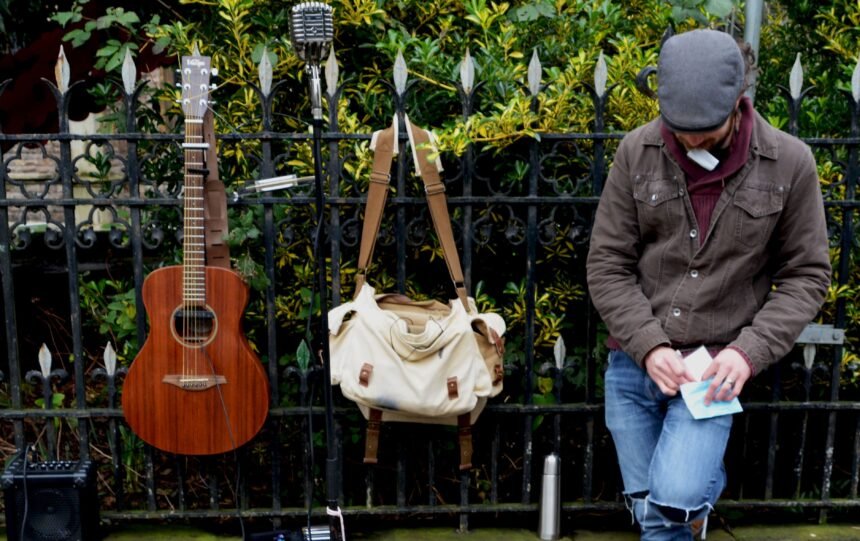
The Backpacker’s whole reputation rests on one use case: a guitar you don’t have to think twice about taking somewhere a real acoustic would be a liability. Buskers use it because a dent or a scratch doesn’t matter and it fits across a backpack between pitches. Long-haul backpackers and round-the-world travellers use it for the same reason the name implies, it survives a rucksack better than anything with a proper waist and bout. Touring musicians sometimes keep one in a flight case as a hotel-room practice guitar, since it’s one of the few steel-strings that genuinely disappears into hand luggage.
What it isn’t is a guitar you buy to replace your main acoustic for a few months of travel. The small soundbox means it can’t do what a dreadnought or even a Baby Taylor-sized body does for projection and tone, and if you’re gigging or recording on the road, that difference shows up fast. Think of it as insurance against boredom and stiff fingers, not as your actual instrument for the trip.
If you want something more conventional instead
The Backpacker’s shape is a genuine love-it-or-hate-it decision, and plenty of guitarists want the portability without the paddle body. If that’s you, our Journey Instruments Puddle Jumper review covers a short-scale steel-string that folds down smaller still but keeps a recognisable acoustic shape, closer to a normal guitar in both looks and tone. Our complete UK buyer’s guide runs through every travel guitar on the site by budget and situation, including several that fit the same “spare guitar for the road” brief as the Backpacker without the unusual body. If you want a small steel-string with a normal guitar shape, the Martin Little Martin and the Alvarez Little Jumbo are the two to look at.
FAQ
Is the Martin Backpacker still made?
Yes. It is a current model on Martin’s own site.
Is it a real guitar, or a novelty?
Both, honestly. It’s fully playable and properly built, solid spruce top, solid sapele back and sides, but the body is so small that it sounds thin next to a full-size acoustic. Treat it as a travel-only spare, not a replacement for your main guitar.
Can I buy one secondhand in the UK?
Yes, they turn up reasonably often on eBay UK and at usual secondhand dealers, since Martin has sold the Backpacker continuously since 1992 and a lot of them are out there. Check the fingerboard and bridge for the same wear and cracking you’d look for on any older solid-wood guitar.
What does it cost new?
From around £359 at UK dealers such as guitarguitar.co.uk.