


Most “travel guitar” advice is written for someone who hasn’t started playing yet. That’s not you. You already know what a dead spot on the fretboard sounds like, you can hear when intonation drifts past the twelfth fret, and you know within thirty seconds of plugging in whether an onboard preamp is going to embarrass you in front of a room. This post is about which compact guitars actually survive that test, not which ones look nice in a listicle photo.
Not every compact acoustic marketed as a “travel guitar” is one. Some are just small acoustic guitars with a travel-guitar headline stuck on top: a full-size dreadnought with no pickup, or a full 4/4 nylon-string classical guitar aimed at children and complete beginners. Neither belongs here, no matter how well either one plays, and a third option is currently unavailable to buy.
Best for X, before you scroll further
- Best for actually gigging with it: the Journey Instruments OF882C, because it’s the only guitar here built with a real cutaway, a genuine full scale, and electronics good enough that reviewers keep comparing it to guitars three times the price.
- Best if weight is your only problem: the Traveler Guitar Ultra-Light, still the lightest true full-scale option on this list.
- Best tone for the money: the Faith Nomad Mini-Neptune, solid wood all through, built by a UK-designed brand that gigging acoustic players already trust.
- Best for surviving actual touring conditions: the KLOS carbon fibre travel guitar, because temperature and humidity swings simply don’t touch it.
- Best budget backup: the Adam Black O-2TE, a genuine Fishman-equipped electro-acoustic for under £200, though it’s new enough to Amazon that you’re taking more of a punt on it than the others.
Travel guitars for experienced players compared
| Guitar | Best for | Scale / size | Electronics | Price band, checked 3 September 2026 |
|---|---|---|---|---|
| Traveler Guitar Ultra-Light Acoustic-Electric | Minimum weight, maximum scale length | 24.75″ full scale, under 1.4kg | Piezo pickup, 1/4″ jack out | From £249 |
| Journey Instruments OF882C (Acacia Koa) | Genuinely gigging on the road | 24.5″ scale, folds to carry-on size | Tri-piezo pickup | From £779, direct from Journey Instruments UK, not Amazon |
| Faith Nomad Mini-Neptune | Tone and build quality | Narrower travel-friendly body, solid mahogany and spruce | Fishman Sonicore pickup, Isys T preamp | From £548 |
| KLOS Black Carbon Fibre Travel | Durability across climates and constant travel | Full scale, around 1.4kg, detachable neck | Fishman Sonitone preamp | From £1,179 |
| Adam Black O-2TE | A cheap, genuinely wired backup | Compact travel-sized body | Fishman Sonitone pickup | From £195 |
What I’d actually trust on stage
If someone handed me one of these an hour before a set, I’d take the Journey Instruments OF882C. It’s the only guitar on this list built with a real cutaway for upper-fret access, a genuine tri-piezo pickup rather than a single under-saddle strip, and a full scale that doesn’t force you to relearn your fretting hand. Reviewers who’ve actually gigged with it mention “excellent intonation” and locking tuners that hold pitch through a set, which is exactly the kind of detail a beginner post never checks and a working player always does.
The Faith Nomad Mini-Neptune is the other one I’d trust without hesitation, mostly because Faith Guitars already has a reputation among UK gigging acoustic players for solid-wood builds at a fair price, and this one carries a proper Fishman preamp rather than a passive pickup with no tone shaping. It’s narrower than a standard travel guitar’s body, so genuinely portable, without giving up the resonance you get from solid mahogany and spruce.
The Traveler Ultra-Light earns its place back on this list because it does one thing better than anything else here: it’s the lightest true full-scale option going, and the piezo pickup and 1/4″ output mean it plugs into any travel amp built for acoustic players without a fuss. Be honest with yourself about what you’re buying it for, though. More than one reviewer has said outright that they wouldn’t use it as a stage guitar unplugged, since the small soundbox just doesn’t have the resonance of a full-body acoustic. Plugged into a PA it’s a different story. Unplugged in a dressing room, it isn’t.
The five, in detail
Traveler Guitar Ultra-Light Acoustic-Electric
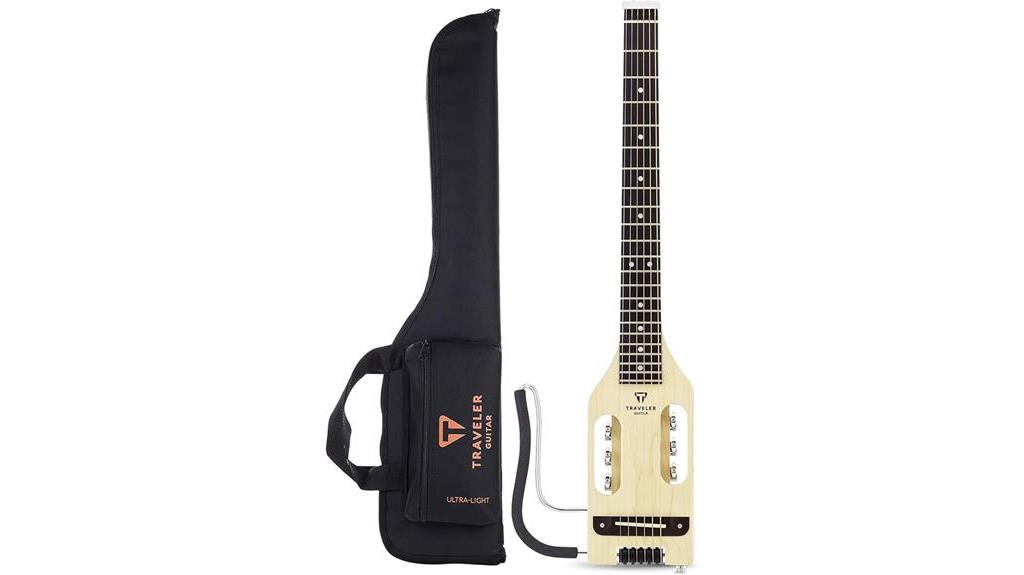
This is the one guitar that survived from the original version of this page, and it survived because it’s a genuine travel instrument rather than just a small acoustic. The In-Body Tuning System removes the headstock entirely, which is how Traveler gets a full 24.75″ scale into something under three pounds and 28 inches long. It comes with a piezo pickup and a standard 1/4″ output built in, and a gig bag as standard.
The catch, and it’s a real one for a gigging player, is volume and resonance unplugged. One reviewer who’s flown with theirs for years put it plainly: it’s “better than my full-size guitar” for travel, but it needs an amp or headphone amp to be heard properly in anything but total silence. If you’re pairing it with a small PA or an amp anyway, that’s a non-issue. If you want something you can strum unplugged backstage and have it sound like a real guitar, it isn’t that.
Journey Instruments OF882C, solid Acacia Koa
Journey Instruments builds guitars specifically for players who fly with an instrument constantly, and it shows. The OF882C folds down to carry-on size in around 20 seconds using a patented neck-locking system, but unlike the cheaper Journey models, it comes with a genuine full 24.5″ scale, a 1.75″ nut, a Florentine cutaway for upper-fret access, and a tri-piezo pickup built in.
Worth flagging honestly: Journey’s own entry-level Puddle Jumper model (no pickup, roughly half the price) has had at least one reported case of poor intonation out of the box, according to a UK reviewer of that specific model. That’s not this guitar. The OF882C sits higher in Journey’s range, and the UK and US reviews for this exact model consistently mention accurate intonation up the neck and tuning stability through a full gig, which is the detail that actually matters if you’re the one on stage. If you’re deciding between Journey’s range, this is the one built for performance rather than just for the plane ride.
See it at Journey Instruments UK
Faith Nomad Mini-Neptune
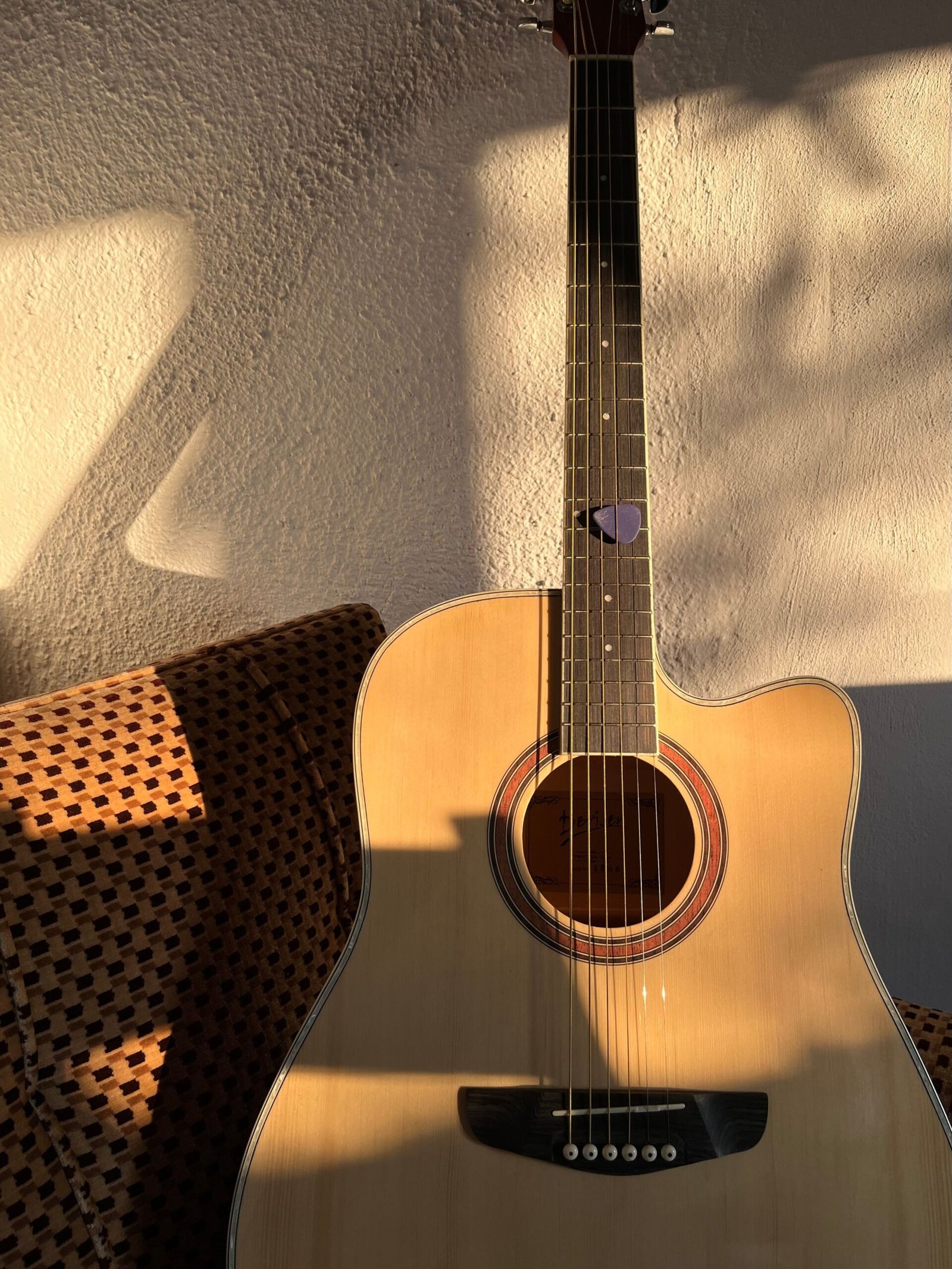
Faith Guitars is designed in Shropshire by luthier Patrick James Eggle, and this Nomad Mini keeps the solid mahogany back and sides and solid spruce top that Faith’s full-size guitars are known for, just in a narrower, more travel-friendly body. It’s fitted with a Fishman Sonicore pickup and Isys T preamp, the same electronics family used in some considerably more expensive small-bodied acoustics.
What you’re paying for here is tone rather than novelty. Owners of Faith’s mini-bodied guitars regularly compare them favourably against a Baby Taylor or Little Martin for resonance and low-end warmth, which matters if you’re the kind of player who notices when a small-bodied guitar sounds boxy the moment you strum a full chord. If your set list leans on fingerstyle or open tunings where tone actually carries the arrangement, this is the guitar on this list built to reward that.
KLOS Black Carbon Fibre Travel Acoustic-Electric
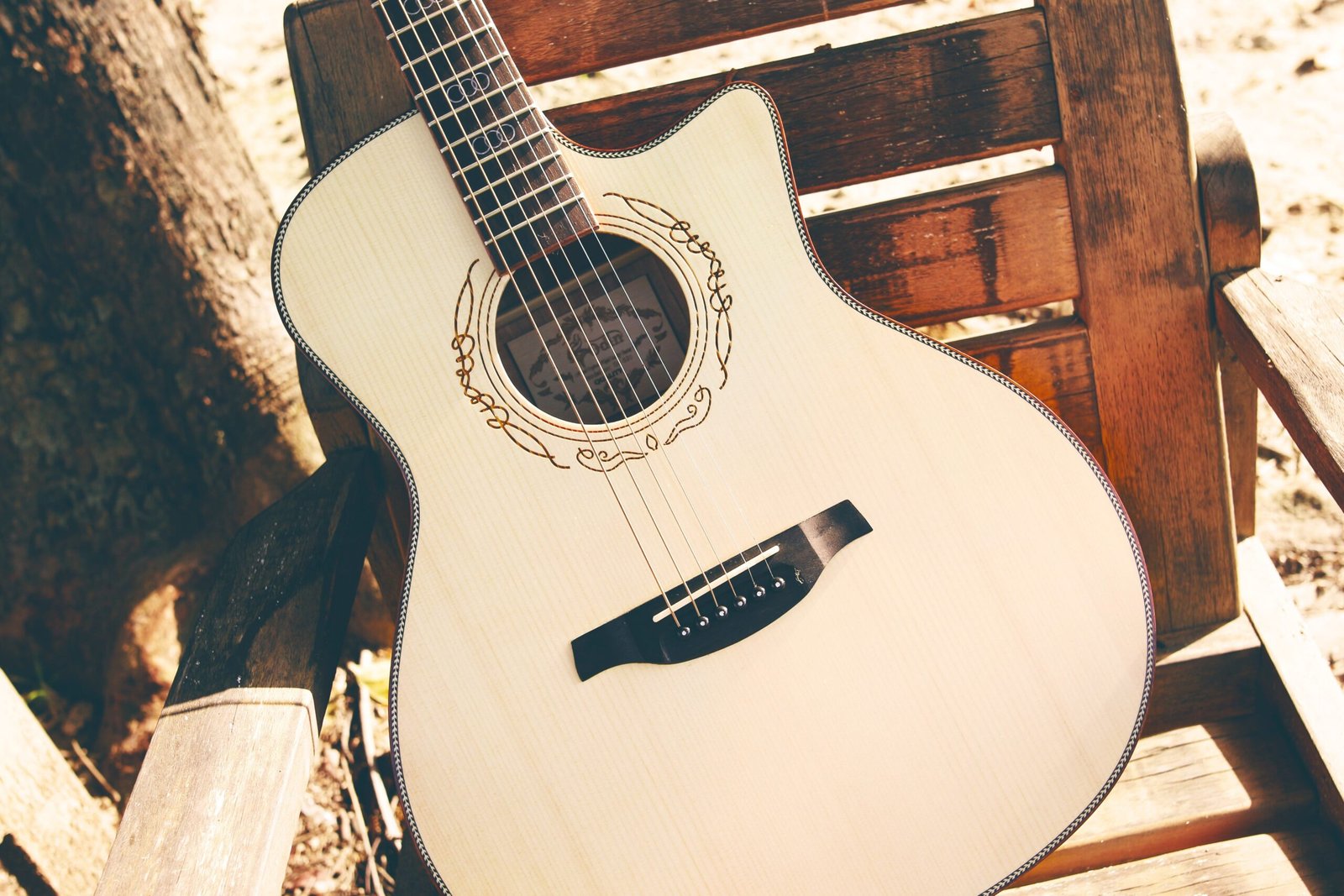
This is the guitar to buy if you’re the player who’s already lost an instrument to a cracked top after one too many climate changes on tour. Carbon fibre doesn’t warp, doesn’t crack, and doesn’t care whether you’ve just flown from a humid gig in Bangkok to a dry venue in Denver. The neck detaches with four screws for even easier packing than a standard travel guitar case allows, and it’s fitted with a Fishman Sonitone onboard preamp with volume and tone controls at the soundhole.
It’s also, by a wide margin, the most expensive guitar on this list, and it’s worth being clear-eyed about why. You’re not paying for a beginner’s travel guitar here, you’re paying for a genuine touring instrument that happens to fold down small. If that’s not the problem you’re solving, one of the cheaper options above will serve you better. If it is, nothing else on this list comes close on durability.
Adam Black O-2TE
The honest way to describe this one is promising rather than proven. It’s a genuinely travel-sized electro-acoustic with a Fishman Sonitone pickup fitted as standard, the same pickup family fitted to guitars costing several times more, and a sapele top, back and sides that should hold up fine to normal handling. At the time of writing it has a single Amazon review, which isn’t enough to make a confident call on long-term reliability or unit-to-unit consistency.
Treat it as what it’s priced to be: a genuinely wired, gig-capable backup guitar for well under £200, not your first-call instrument for a paid booking. If you already own a main travel guitar from this list and want a cheap electro-acoustic spare to leave at a rehearsal space or a second property, this is a sensible way to spend £195 rather than buying another beginner-grade guitar with no pickup at all.

What actually matters if you already gig
The Fender CC-60S and the Yamaha F310 are both perfectly decent guitars for what they’re built for, learning to play, but neither belongs on this list. Neither has a pickup, and neither is meaningfully more compact than a standard acoustic, so neither answers the question this page exists to answer. The Cordoba CO081 is a full 4/4 classical guitar with nylon strings and no electronics at all, built for children and absolute beginners, not gigging players looking for something compact. The Ibanez EWP14-OPN piccolo is currently unavailable to buy new on Amazon UK, which settles that one on its own.
What should actually decide your choice from the five above is how you intend to use the guitar. If you’re flying to a gig and plugging into a house PA, intonation up the neck and a genuine pickup matter more than anything else on a spec sheet. If you’re mostly practising quietly in hotel rooms between shows, weight and a headphone amp option matter more than tone. Worth reading alongside this if either applies to you: our review of the Traveler Speedster Deluxe, which has a headphone amp built in, and our full breakdown of UK airline rules for taking a guitar on a plane, since the rules differ enough between carriers to catch out an experienced player who’s only ever checked one airline’s policy.
A travel guitar that can’t hold its tuning through a set is a liability, not a convenience. Get a decent clip-on tuner regardless of which guitar you choose here, since even the best-built travel necks move more than a full-size guitar’s after a flight. And whichever guitar you land on, protect it properly in transit. A gig bag is fine for a taxi to a local gig, but if you’re checking a guitar or handing it to baggage handlers, it’s worth reading our guide to travel guitar cases built for the road before you find out the hard way what a laminate top does after rough handling.
Frequently asked questions
Do any of these sound as good as a full-size acoustic unplugged?
Not really, and it’s worth being honest about that rather than pretending otherwise. Smaller soundboxes move less air. The Faith Nomad Mini-Neptune and the KLOS come closest thanks to solid tonewood and carbon fibre resonance respectively, but every guitar on this list is built to be heard properly through a pickup, not to replace a full-size acoustic’s unplugged projection.
Is a piezo pickup good enough for a paid gig?
Yes, provided the preamp behind it lets you shape the tone rather than just boosting volume. That’s the real difference between the Fishman Sonicore and Isys T systems fitted to the Faith and KLOS, and a bare passive piezo with no EQ. If a venue has a decent PA and a sound engineer who knows how to EQ an acoustic pickup, any of the electro-acoustics above will get you through a set cleanly.
Why isn’t the Yamaha F310 or Fender CC-60S on this list anymore?
Because neither is a travel guitar. Both are full-size, standard-scale acoustics with no built-in electronics, aimed squarely at beginners. They’re good guitars for what they’re built for, but they don’t solve the actual problem an experienced, gigging player has, which is fitting a stage-capable instrument into a bag.
Should I buy the cheapest option here as my only travel guitar?
Only if your budget genuinely doesn’t stretch further, and even then, go in with your eyes open. The Adam Black O-2TE has real electronics for the money, but it’s new enough to Amazon that there’s very little track record to judge it against. If this is going to be your main instrument on the road rather than a spare, the Traveler Ultra-Light or Faith Nomad Mini-Neptune are the safer bet.
If you’re weighing this against guitars built for a different situation, our guide to the best travel guitars covers how to choose by budget, playing style and how you’ll actually travel.
The bottom line
An experienced player doesn’t need a smaller version of a beginner’s guitar. You need something that plugs in properly, holds its intonation past the twelfth fret, and survives being packed away after every show. Of the five guitars here, the Journey Instruments OF882C is the one built specifically for that job. The Faith Nomad Mini-Neptune is the one to pick if tone matters more to you than anything else. And if you already know your touring schedule is going to punish a guitar physically, year after year, the KLOS carbon fibre build is the only one on this list actually engineered for that.