

Most short-scale guitars on this site still tune to standard EADGBE, just on a smaller body. The Ortega RGLE18ACA doesn’t. It’s a guitarlele, tuned A-D-G-C-E-A, a fourth above standard, the same idea as the Yamaha GL1 already reviewed on this site. What’s different is what’s actually inside it: a solid acacia top instead of the GL1’s laminate build, and an onboard preamp with tuner instead of no electronics at all.
Best for: a guitarist who wants a genuine solid-top instrument they can plug into an amp or PA, not just a cheap grab-and-go practice piece. If price matters more than tonewood or electronics, the GL1 at under a quarter of the price does a similar job. If you want your fretting hand doing exactly what it does on a full-scale neck, look at the Traveler Ultra-Light Acoustic-Electric instead. Check price on Amazon.
What the RGLE18ACA actually is
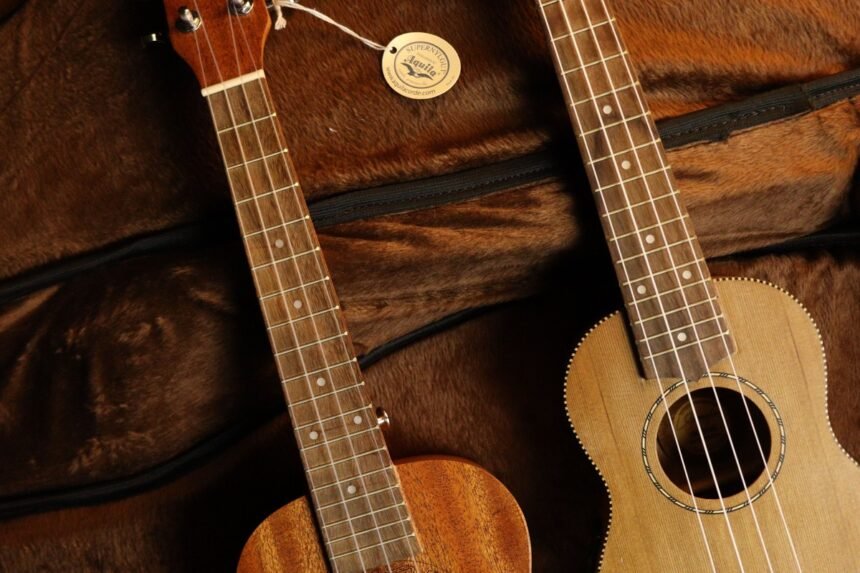
It’s part of Ortega’s Mini | Travel Series, a small range built around the same body shape in different tonewoods (the Flamed Mahogany version is the other one you’ll see on Amazon UK). This one has a solid acacia top with acacia back and sides, both in a gloss finish, a mahogany neck, and a walnut fretboard and bridge. The body’s bound in maple with abalone-style purfling, and the soundhole gets the same abalone-style rosette. Tuners are open-geared, gold-finished, with marble-style buttons. It has 18 frets, a 435mm (17.1in) scale, and a nut width of around 45mm.
Solid wood matters more here than the spec sheet makes it sound. A laminate top like the GL1’s stays roughly the same from the day you buy it. A solid top opens up and resonates more as it ages, which is the reason to choose this over a similarly priced guitarlele with a plywood top. It also means you need to think about humidity when you travel, especially through dry aircon cabins or winter heating; our guide to guitar humidifiers for travel is worth reading alongside this one.

The tuning is the part to get straight before you buy
This isn’t a small guitar you tune the normal way. It’s tuned A-D-G-C-E-A, a fourth higher than a standard guitar’s E-A-D-G-B-E, the same interval as capoing a normal guitar on the fifth fret. Every chord shape you already know works exactly the same way, you’re just playing it higher in pitch. Ortega’s own listing notes it can also be tuned down to E or A if you’d rather match a specific reference pitch, but A-D-G-C-E-A is what it ships tuned to and what the scale length and string gauges are built around.
If you want an instrument you can tune to standard pitch and play your usual chord shapes at their usual pitch, this isn’t that guitar, and neither is the GL1. Both are guitarleles first and travel guitars second. If standard tuning matters more to you than the size, the Traveler Ultra-Light or one of the standard-tuned picks in our under-£300 roundup are the better fit.
Solid top and real electronics: the actual reason to pick this over the GL1
The GL1 and the RGLE18ACA solve the same basic problem, a genuine six-string instrument small enough to live in hand luggage, but they’re not really competing on price. The GL1 is a laminate-body instrument with no electronics at all, built to be cheap and durable. The RGLE18ACA has a solid acacia top and Ortega’s own MagusUke preamp with a built-in tuner, so you can plug it into any acoustic amp or PA the same way you would a full-size electro-acoustic. That electronics package and the solid top are the whole reason it costs roughly four times as much. If you’re after a permanent, low-stakes travel companion, the GL1 remains very hard to beat for the money. If you actually plan to plug in and play out, or you care about tone improving over years rather than staying static, the RGLE18ACA earns its price.
| Ortega RGLE18ACA | Yamaha GL1 Guitalele | |
|---|---|---|
| Price (from) | £377 | £89 |
| Tuning | A D G C E A (a fourth up) | A D G C E A (a fourth up) |
| Top, back and sides | Solid acacia | Laminate spruce top, meranti back and sides |
| Electronics | Ortega MagusUke preamp with onboard tuner | None |
| Case included | Deluxe padded gig bag | Fitted gig bag |
| Best for | Plugging in, tone that develops over years | Permanent travel companion, casual unplugged play |
The honest downside
Unamplified, the RGLE18ACA is on the quiet and thin side, which comes with the territory on any short-scale, small-bodied guitarlele rather than being specific to this one. One detailed owner account online described it as genuinely disappointing unplugged, but said it opens up considerably once it’s run through an acoustic amp, which matches what the onboard electronics are actually there to do. The same account flagged the stock strings as unusually loose and soft under the fingers out of the box, something a fresh set of strings and a short settling-in period should improve. Worth knowing before you buy: this is an instrument that’s built to be plugged in, not one that happens to have electronics as an afterthought.
Where to buy it
Amazon UK sells the RGLE18ACA directly, genuine buy box, £377 (checked 4 September 2026). See latest price on Amazon.
Frequently asked questions
Is the Ortega RGLE18ACA the same as the Yamaha GL1?
No, though they’re the same type of instrument. Both are guitarleles tuned A-D-G-C-E-A on a similar short scale. The RGLE18ACA has a solid acacia top and onboard electronics; the GL1 is laminate-bodied with no electronics and costs roughly a quarter of the price.
What does A-D-G-C-E-A tuning actually mean for a guitarist?
It’s the same as capoing a standard guitar on the fifth fret. Every chord shape you already play works identically, you’re just playing it higher in pitch on a shorter, smaller instrument.
Can I tune the RGLE18ACA to standard EADGBE?
Ortega’s own spec allows tuning down to E or A, but the instrument is built and strung around A-D-G-C-E-A. If you want standard pitch on a genuinely full-scale neck, a short-scale guitarlele like this isn’t the right instrument, look at a proper short-scale travel guitar instead.
Does the solid acacia top actually matter, or is it just marketing?
It’s real. Solid wood resonates more and keeps improving as it ages, where laminate tops stay roughly static from day one. It’s also the reason this costs more than a laminate guitarlele like the GL1, and it’s the main thing you’re paying for alongside the electronics.
Do I need an amp for this to sound good?
Not strictly, but it helps a lot. Unamplified, small-bodied guitarleles like this one are naturally quiet and thin sounding. The onboard Ortega MagusUke preamp is there specifically so you can plug into an acoustic amp or PA and get a fuller sound out of it.
What’s included in the box?
The guitar itself and a deluxe padded gig bag with a carry handle, enough to protect it in transit without buying a separate case.