

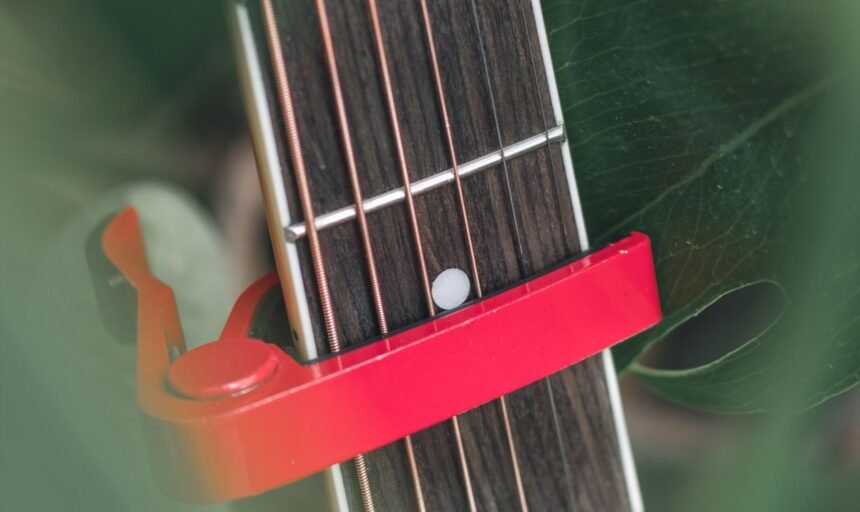
Most capo reviews assume a standard dreadnought neck. Travel guitars often don’t have one. Mini and parlour-scale necks are frequently narrower and slimmer than a full-size acoustic, and that changes how a capo behaves, sometimes enough to pull your strings sharp or leave a string buzzing. It’s a genuine, documented issue with at least one popular capo.
These three cover the real differences that matter for a narrower travel neck: adjustable tension versus fixed spring pressure, and how fast you can get the capo on and off.
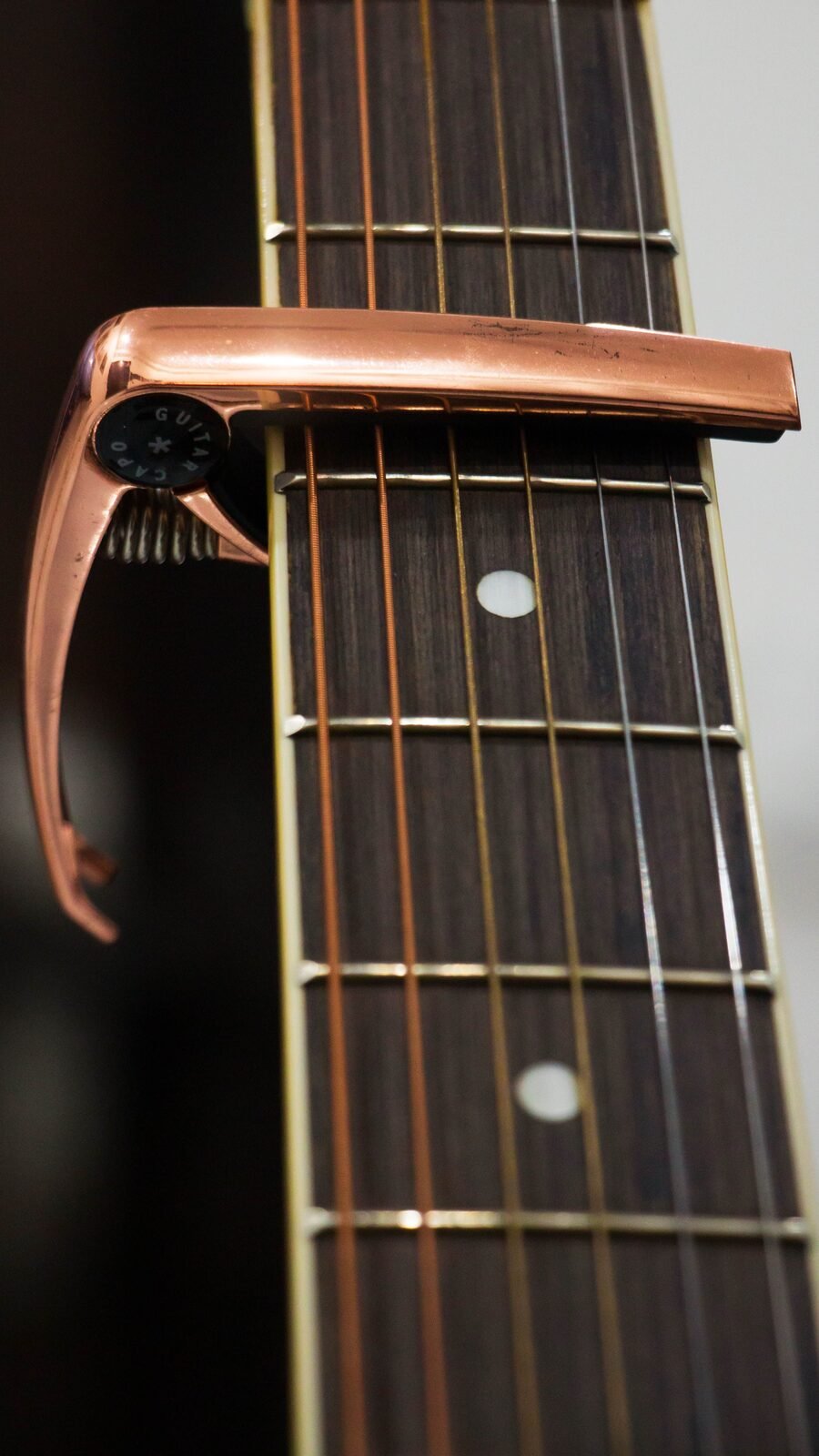
Best for narrow travel necks: Shubb C1
The Shubb C1 has a screw-adjustable tension roller, so you set the clamping pressure to match your own guitar rather than accepting whatever a fixed spring gives you. On a narrower travel or mini neck, that means you can wind it down just enough to fret cleanly without over-pressing the strings sharp, something a fixed-tension capo can’t do. It’s also low profile and light, which suits a gig bag better than a bulkier trigger-style capo.
The trade-off is speed. Fitting it properly means turning a small screw, not squeezing a lever, so it’s noticeably slower than a quick-change capo if you’re swapping position mid-song. Once it’s set for a given guitar, though, you rarely need to readjust it again.
Good for: travel guitars with narrower or slimmer necks where a fixed-tension capo risks pulling strings sharp.
Fastest quick-release: Kyser Quick-Change
The Kyser is the capo you see on more stages than any other, and for good reason. It’s a one-handed squeeze to fit and a squeeze to remove, quicker than any screw-adjustable design, which matters if you’re changing capo position between songs rather than setting it once and leaving it.
Its spring tension is fixed, though, and this is where the narrow-neck issue actually shows up. Because the clamp opens wider on a thicker neck and less on a thinner one, a slim travel neck gets less give from the spring, and owners of narrower-necked guitars report it can pull strings sharp, particularly with the lighter gauge strings common on minis. The Kyser was designed around standard dreadnought thickness, which is why this happens on narrower necks. Worth checking your tuning after clipping it on if your travel guitar has a slim neck.
Good for: players who change capo position often and want the fastest possible swap, on necks closer to standard thickness.
Best if you own more than one guitar: G7th Performance 3
The Performance 3’s Adaptive Radius Technology flexes to match different fretboard curves, so the same capo works properly across a flat-radius travel neck and a rounder full-size acoustic without you doing anything. If you own both a travel guitar and a standard acoustic and don’t want to buy two capos, this is the one that’s built to cover both.
It’s the most expensive of the three by some margin, and it’s not trouble-free. Some owners report the tension mechanism loosening or sticking after several months of regular use, and it’s not as instantly one-handed as the Kyser. If you only own one travel guitar with a single neck profile, the price is hard to justify over the Shubb.
Good for: players who switch between a travel guitar and a full-size acoustic with a different neck profile.
How they compare
| Capo | Mechanism | Narrow neck fit | Genuine downside |
|---|---|---|---|
| Shubb C1 | Screw-adjustable tension | Best, tension dials to fit | Slower to fit than a squeeze capo |
| Kyser Quick-Change | Fixed-tension spring, one-handed | Can pull strings sharp on slim necks | No tension adjustment |
| G7th Performance 3 | Adaptive radius, tension dial | Good, adapts across guitars | Priciest, some reported mechanism wear |
Frequently asked questions
Why would a capo behave differently on a travel guitar?
Travel and mini guitars frequently have narrower or slimmer necks than a standard acoustic. A capo with fixed spring tension is calibrated around standard neck thickness, so on a narrower neck it can clamp harder than needed and pull strings out of tune.
Which capo is safest for a narrow neck?
The Shubb C1, because you can wind the tension down to exactly what your guitar needs rather than relying on a fixed spring. The G7th’s adaptive design also handles this well, at a higher price.
Can a capo throw a guitar out of tune?
Yes, if it clamps harder than necessary. This is more common with fixed-tension capos on narrower necks or lighter strings. Always check your tuning again after fitting a capo, whichever one you use.
Do I need a different capo for a 12-fret or short-scale travel guitar?
Not usually a different capo entirely, but fit is worth checking. Shorter scale necks can have tighter fret spacing near the nut, so make sure whichever capo you choose seats cleanly at the first two or three frets without buzzing.
The bottom line
Buy the Shubb C1 if your travel guitar has a narrower neck and you want tension you can actually control. Buy the Kyser if speed matters most and your neck is closer to standard thickness. Buy the G7th Performance 3 only if you’re switching between guitars with genuinely different neck profiles and the price doesn’t put you off.
Fitting a capo is exactly the moment to double check your tuning, since even a well-behaved capo can nudge a string sharp. Our guide to the best clip-on tuners for travel guitars covers three that read pitch through the guitar’s body rather than a microphone, useful anywhere quiet.
Buying for a guitarist? Our guide to gifts for guitar players puts a capo alongside other small gifts, with prices checked in October 2026.